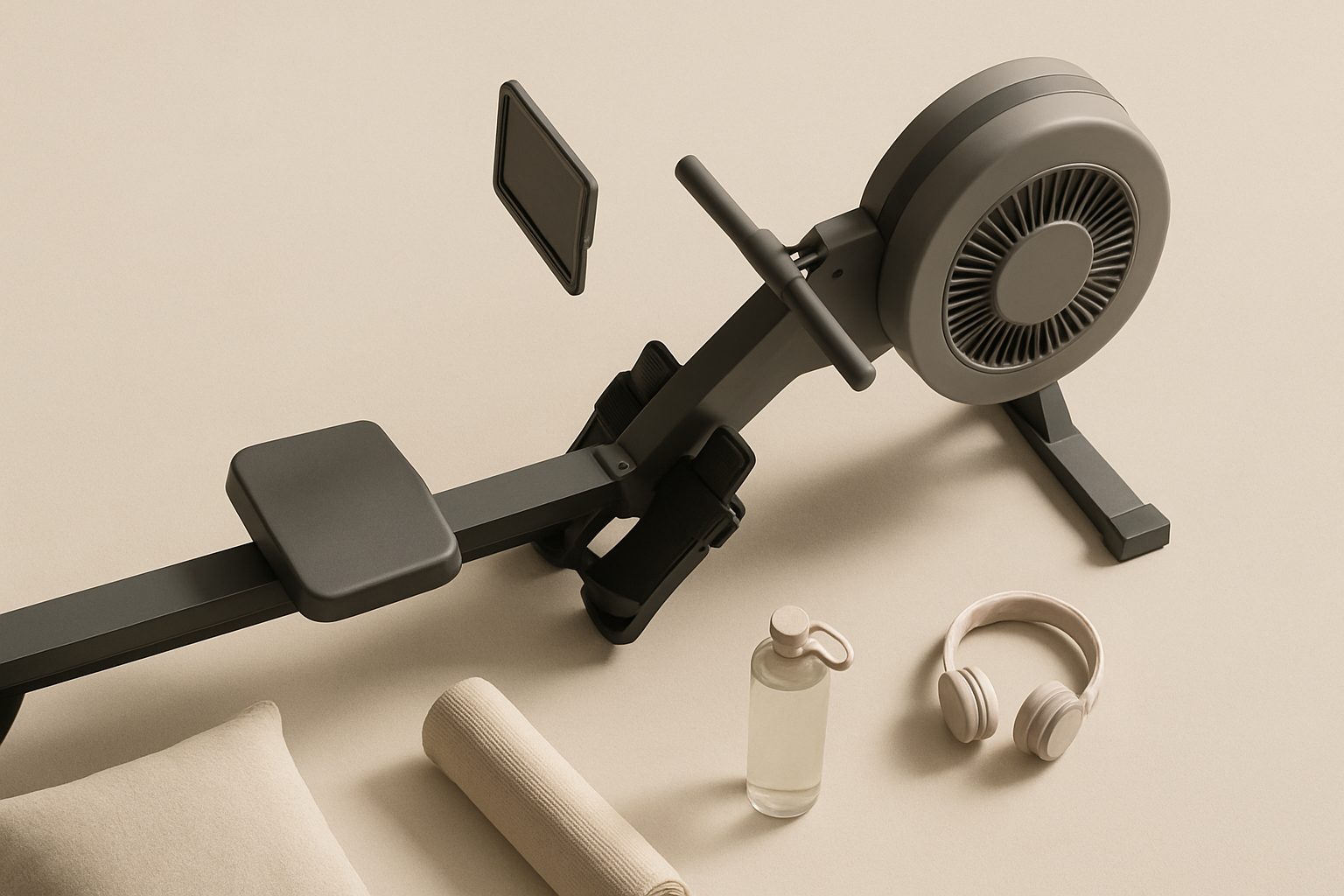
How to Use a Rowing Machine Correctly: Technique Guide for UK Home Users
A rowing machine is one of the most effective full-body cardio tools you can have at home. But if you're just sliding back and forth, you're missing most of the benefit—and probably building bad habits that'll frustrate you later. Proper technique transforms a rowing machine from a leg-thrashing machine into a smooth, efficient workout that engages your entire body and actually feels good.
The good news: rowing machine technique isn't complicated. It's a repeating cycle of four distinct phases, and once you nail them, it becomes automatic. Let's break down what you need to know to row correctly.
The Four Phases of a Rowing Stroke
Think of every rowing stroke as a continuous loop: drive, catch, finish, recovery. Each phase has a specific job, and rushing through them or doing them out of order is where most people go wrong.
The Drive Phase
This is where the power comes from. You're sitting on the slide with your knees bent, feet strapped in, and hands holding the handle at chest height.
Push with your legs first. This is the biggest mistake people make—they pull with their arms straight away. Your legs are the largest muscle group in your body, and they should be doing most of the work. Drive your feet hard into the footplate, extending your legs explosively. Your seat will slide backward as your knees straighten.
As your legs drive, keep your arms relatively straight. Your shoulders should stay relaxed and connected to your core. About three-quarters of the way through the leg drive, your back naturally follows into the movement—a slight lean backward from the hips, not a dramatic arch. Think of your legs doing the heavy lifting, then your back adding the finishing power. Your arms are just the link between you and the handle at this stage.
The drive should feel powerful and controlled, not jerky. If you're bouncing or feeling unstable, you're pushing too hard or losing your posture.
The Catch Phase
Once your legs are fully extended and your back is set, you're at the catch—the end of the drive. Your legs are straight (not hyperextended), your core is braced, and you're leaning slightly back. This is the moment you pause, just for a fraction of a second, before reversing direction.
Most people skip this moment entirely. They drive and immediately start pulling. That split-second pause at full extension is crucial: it's where you reset, catch your breath momentarily, and prepare for the pull.
The Finish Phase
Now you're pulling with your arms, using your back and arm muscles to bring the handle to your chest. Keep your elbows close to your body—not flared out to the sides. Squeeze the handle and bring it smoothly to just below your chest, where your ribcage is.
The finish is the second-smallest muscle group doing the work (after the arms themselves in the leg-driven action). This is the final burst of power in the stroke. Your body position stays strong: legs fully extended, back set.
At the end of the finish, you've brought the handle to your chest, your arms are bent, your back is still engaged. This is the point before you reverse the motion entirely.
The Recovery Phase
This is where you return to the starting position. It's not passive—it's controlled.
First, extend your arms away from you while keeping your legs straight. Then, as your arms fully extend, start hinging forward at the hips, bringing your chest toward your thighs. Only when your hands have cleared your knees do you bend your legs again and slide forward on the seat.
The recovery is the longest phase of the stroke, roughly as long as the drive, catch, and finish combined. It's where you recover your breathing and energy for the next stroke. This should feel smooth and controlled, not rushed.
Common Mistakes to Avoid
Pulling with your arms first. Your arms are skinny compared to your legs. Use your power source first.
Slouching or rounding your back. Poor posture transfers energy inefficiently and puts stress on your spine. Sit upright with engaged core.
Jamming your knees. Your knees should flex naturally—never lock them straight. This prevents injury and keeps the movement efficient.
Bouncing at the catch. That pause at full extension is crucial. Bouncing means you're yanking the handle back instead of controlling it.
Leaning too far back. A slight lean helps finish the stroke, but if you're arching dramatically, you're relying on momentum rather than muscle control.
Going too fast too soon. New rowers often whip through strokes at high speed. Slow down, nail the technique, then increase pace. A controlled 22 strokes per minute beats a sloppy 30 any day.
Getting Started the Right Way
If you're new to rowing, spend your first few sessions at low intensity, focusing purely on technique. Record yourself or use a mirror if your machine is positioned where you can see one. Many rowing machines have built-in form feedback, and some apps do too.
A solid beginner plan: 10 minutes of low-intensity rowing, 3 times a week, while you develop the movement pattern. Once it feels automatic, you can add intensity or duration.
If you're unsure whether your technique is solid, consider watching form videos alongside your first sessions—YouTube has plenty of solid beginner breakdowns. Reading this guide is a start, but seeing the movement in motion clicks faster for most people.
Once you've got your technique locked in, rowing becomes genuinely enjoyable. You'll feel the power, the smoothness, the full-body engagement. That's when a rowing machine becomes the training tool it actually is.
Ready to find the right machine for your home? Check out our guide to beginner rowing machine picks for UK homes—it covers machines that'll last and won't clutter your space.
More options
- Concept2 RowErg Indoor Rowing Machine (Amazon UK)
- WaterRower Natural Rowing Machine (Ash Wood) (Amazon UK)
- Bluefin Fitness Sprint 2.0 Magnetic Rowing Machine (Amazon UK)
- JLL R200 Home Rowing Machine (Amazon UK)
- Jorvik Tri-Mode Water Rowing Machine (Amazon UK)